
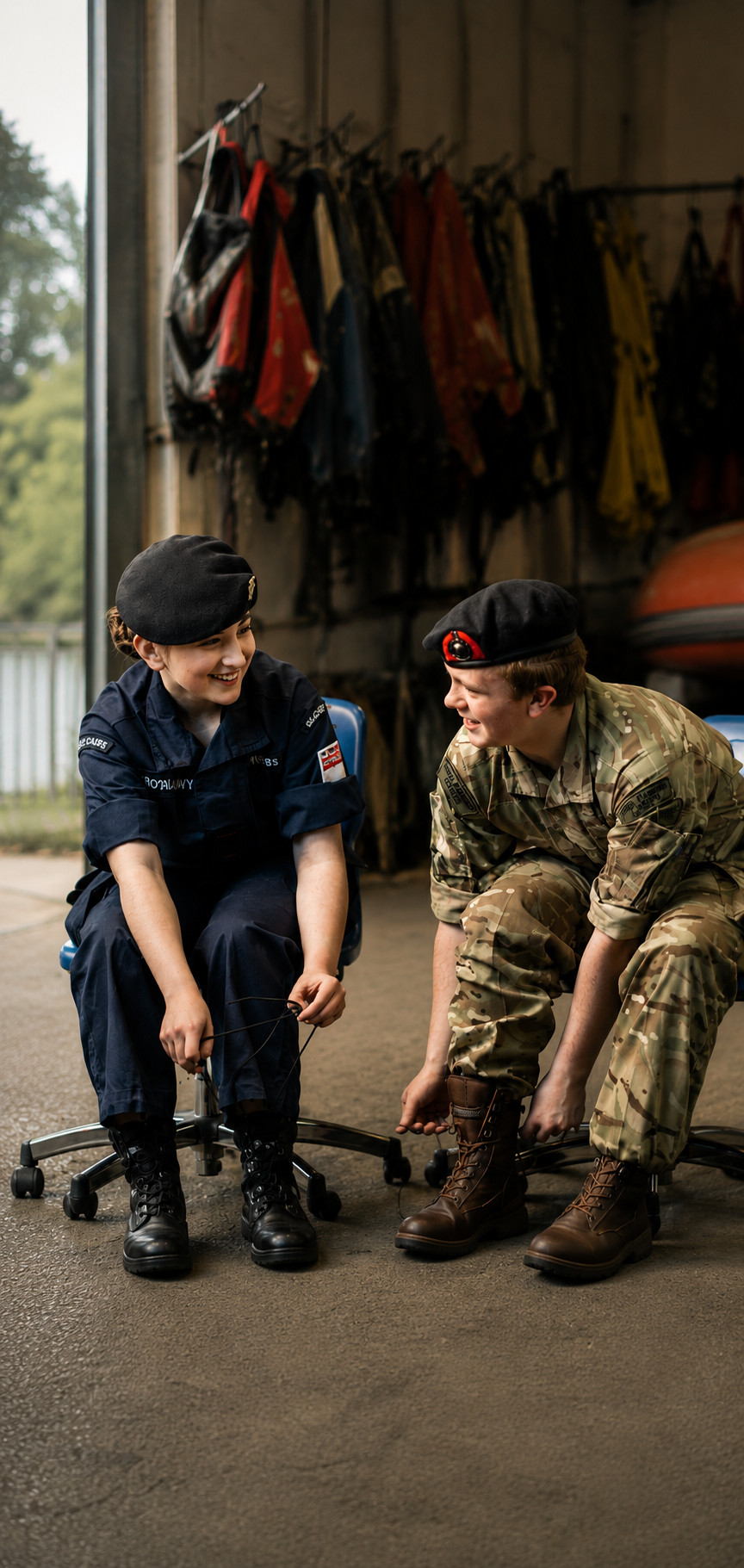
We don't give young people confidence. We give them reasons to become confident.
At twelve years old, very few people know what they are good at. Some have already been given clues: they are good at exams, football, music, making people laugh, or simply being the sort of child who seems instinctively to understand how the world around them works. Others have accumulated rather more evidence about the things they apparently aren't good at. Then somebody puts them in a boat.
For the first time, perhaps, an adult isn't asking them simply to sit still and absorb information. They are teaching them to do something real. There is a right way to rig a boat, a reason for every instruction and a fairly immediate consequence if nobody pays attention. The water is wonderfully uninterested in school reports, popularity or whether you are usually the first person to put your hand up. You learn, get things wrong and try again. Eventually, almost imperceptibly, you become competent. Then one evening somebody newer than you doesn't know what to do, and you do.
We tend to call what happens in between “building confidence”. I think that undersells it.
Confidence is the consequence
Youth organisations talk a great deal about confidence, resilience, teamwork and leadership. Sea Cadets is no exception, with good reason: these are among the outcomes the organisation explicitly seeks to develop, and its own research suggests parents and cadets see substantial benefits in precisely these areas. They are good words describing important things. Repeated often enough, however, they risk becoming the linguistic wallpaper of anything involving young people and matching T-shirts.
What interests me more is how those qualities actually develop. Telling a young person to believe in themselves has its place; giving them evidence that they should is considerably more powerful. Teach a twelve-year-old to row a boat and they have learnt something tangible. Let them earn a qualification and their competence has been independently recognised. Give them responsibility for helping somebody else and competence begins to become confidence. Put them in charge and confidence starts acquiring judgement. Allow something to go wrong occasionally and resilience gets involved too.
This is one of the things Cadet Forces do particularly well. There are standards and expectations. Progress requires effort. Praise matters, but achievement has substance behind it. Young people discover that they can do difficult things because, eventually, they have done difficult things. The distinction matters, because confidence acquired through competence is rather more useful than confidence acquired through encouragement alone.
The military appearance can create a misleading impression of what all this is ultimately for. Some cadets will go on to careers in the Royal Navy, Royal Marines or elsewhere in the Armed Forces, and for them their cadet experience may prove an extraordinary foundation. Most won't. Sea Cadets itself describes what young people gain as relevant whatever they choose to do after school, and its research into former cadets found transferable benefits across a wide range of later careers, including those far beyond the Armed Forces and maritime sector.
The naval traditions are nevertheless important because they provide part of the framework in which development happens. There is a uniform, so one visible marker of difference largely disappears. There is a routine, so people know what happens next. There are ranks, so responsibility is visible; standards, so expectations are clear; and traditions which quietly tell a twelve-year-old that this thing existed before they arrived and will continue after they leave. The structure is part of what Sea Cadets itself identifies as distinctive about its approach.
There is also discipline, a word that occasionally makes modern adults twitch because it is too easily associated solely with punishment. The more interesting form is self-discipline: learning to be somewhere when you said you would be; looking after equipment; finishing an unpleasant job properly; listening when somebody else knows more than you; accepting correction without taking it personally; and discovering that being part of a team occasionally means doing something because it needs doing rather than because you particularly fancy it.
These are not exclusively military skills. They are adult ones.
Another place to succeed
Perhaps the greatest value of organisations such as Sea Cadets is that they give young people another arena in which to discover themselves. School necessarily measures certain abilities extremely well. Sport discovers another set; music, drama and countless other activities reveal others. Cadet life casts an unusually wide net: sailing, rowing and powerboating sit alongside navigation, seamanship, engineering, first aid, adventure training, physical challenge, drill, ceremonial, community service, technical skills, teaching and leadership. Sea Cadets' own description of its programme similarly emphasises learning through activities, on and off the water, rather than simply through conventional classroom instruction.
That variety matters because children are inconveniently resistant to standardisation. The child who struggles to shine in a classroom may turn out to have exceptional practical judgement. The quiet one may discover that people listen when they actually have something to say. The youngster who appears incapable of standing still may possess exactly the energy required when everyone else is exhausted. The meticulous child who worries about details may discover an environment where details matter. A young person who has spent a considerable amount of time being shown where they sit in somebody else's hierarchy of ability gets another chance to discover that the hierarchy changes when you measure something different.
Even the child who is already thriving gets something valuable: exposure to people who think, communicate and solve problems differently from them. Sooner or later they have to work together, and that requires more than tolerance. It means learning to communicate with the person actually standing in front of you rather than the imaginary person who thinks, learns and responds exactly as you do. That is leadership in a form rather closer to real life than most textbooks manage.
Then something subtle happens. A new cadet arrives not knowing where to stand, how the uniform works or what half the terminology means. Perhaps they are nervous and trying desperately not to show it. Two years later, that same cadet may be the one who notices a newcomer struggling and quietly steps in to help. The young person who once needed looking after has become somebody who looks after others; the child who needed instruction becomes the instructor; the cadet who once followed acquires enough competence that somebody decides they are ready to lead.
Rank can be part of that journey, but the badge is the least interesting bit. The important moment comes when a young person realises that other people are now relying on them. Responsibility changes the significance of ordinary behaviour. If you are responsible only for yourself, forgetting something is inconvenient; when somebody else is depending on you, the same mistake feels rather different. Leadership begins to become less about the attraction of being in charge and more about accepting accountability for what happens to everyone else.
That is a useful lesson to learn at fourteen.
The adventure is the method
None of this requires pretending that young people join Sea Cadets because they have conducted a sophisticated analysis of their developmental needs. They join because the boats look fun, because their friend goes, because they want to sail offshore, paddle, climb, camp, travel, wear the uniform or simply do something considerably more interesting than another evening staring at a screen.
Good. The adventure is not a distraction from the development. Much of the time, it is how the development happens.
A young person standing on a pontoon about to attempt something they have never done before is learning more than the technical skill being taught. They are discovering what apprehension feels like, whether they can act despite it and what happens when they succeed. Sometimes they fail, which may be more useful still. There will be another boat, another attempt and another parade night. Failure in a safe environment, followed by the expectation that you will learn something and have another go, is one of the more useful experiences we can give a young person.
This is also why reducing Cadet Forces to preparation for military service misses so much of their value. A boat may be the immediate subject of the lesson, but the transferable learning is larger: listen to instruction, understand the problem, work with other people, make a decision, take responsibility for it, adjust when circumstances change and keep functioning when the first plan doesn't survive contact with reality. Sea Cadets' longer-term research describes former cadets carrying precisely these kinds of practical and transferable capabilities into adult life.
Eventually every cadet leaves. Some will take formal qualifications with them; others will have accumulated adventures and stories which will improve with every retelling. Some will discover careers they had never previously considered. A few will join the Armed Forces. Most will walk into completely different lives as engineers, nurses, electricians, teachers, business owners, scientists, tradespeople, managers, parents and a thousand other things nobody could have predicted when they first walked through the door.
And somewhere along the way, perhaps without noticing, they may find themselves standing differently. They speak when something needs saying. They take responsibility when something goes wrong. They notice the person who hasn't quite found their feet. They know how to follow when somebody else is better placed to lead, and how to step forward when they aren't. They remain calm enough to think. When something doesn't work, they try again.
So if you are a parent wondering whether Cadet Forces are appropriate for a child with no intention of joining the Armed Forces, perhaps the better question is not whether your child wants a military career, but who they might discover they can become.
One day they will take the uniform off for the last time. Most will never put another one on. By then, it will have done its job.
Because this was never really about the uniform, the ranks, the boats or even the qualifications. They were the means by which we gave young people responsibility, expected something of them, let them discover what they were capable of and, eventually, trusted them to do the same for somebody else.
It was always about the adults they could become.
kasgraph.com shiftworksai.com DEWAVIP77 CENDANATOTO JOKER77 DEWAVIP77 JOKER77 DEWAVIP77 CENDANATOTO JOKER77 DEWAVIP77 DEWAVIP77 JOKER77 DEWAVIP77